
ER Observation Services in Fort Worth | 24/7 Care
Observation services bridge the gap between emergency care and hospital admission. At ER Of Fort Worth, we offer 24/7 observation units designed to monitor patients who need more than urgent care but may not require a full hospital stay.

In This Article
- What Are Observation Services in an Emergency Room?
- How Does Hospital Observation Work?
- When Is Observation Services the Right Choice?
- Observation Services vs. Inpatient Hospital Admission
- ER Of Fort Worth's Observation Unit: What to Expect
- Observation Services for Fort Worth and North Texas
- Frequently Asked Questions About Observation Services
- Frequently Asked Questions
⚡ Key Takeaways
- Observation services provide structured medical monitoring for patients who need more intensive care than urgent care can offer but not necessarily a traditional hospital admission.
- A typical 23-hour observation stay allows physicians time to diagnose, stabilize, and plan the next care step without committing to inpatient hospitalization.
- Common observation triggers include chest pain evaluation, fever with unclear etiology, acute neurological symptoms, and medication management requiring monitoring.
- Observation units cost less than full hospital stays and often involve fewer insurance complications, making them a practical middle option.
- ER Of Fort Worth's 24/7 observation services are available to Fort Worth residents and patients across Keller, Alliance, Saginaw, Haslet, and surrounding North Texas communities.
What Are Observation Services in an Emergency Room?
Observation services represent a structured level of care that sits between emergency department evaluation and traditional hospital admission. Patients in an observation unit receive continuous monitoring, frequent assessments, and access to diagnostic testing—all within a defined, shorter timeframe than a standard inpatient stay.
An observation services emergency room stay typically lasts up to 23 hours, though some stays may be shorter if a diagnosis is reached quickly. During this time, a patient remains in a dedicated observation bed, receives nursing care, and undergoes repeat exams and tests as clinically indicated. The goal is diagnostic clarity: determining whether the patient can safely go home with outpatient follow-up, needs inpatient admission to a hospital floor, or requires transfer for specialized care.
Observation is not a diagnosis—it is a type of service level. Insurance companies and healthcare regulators recognize observation as distinct from admission, which has implications for billing, length of stay reporting, and patient responsibility. The observation unit doctor—often the same emergency physician who evaluated you initially—directs all care decisions during the stay.
How Does Hospital Observation Work?
When a patient arrives at ER Of Fort Worth with a condition that requires more than an urgent care visit but does not immediately warrant admission, the emergency physician may recommend placement in the observation unit. This decision typically occurs after the initial ER evaluation, during which the provider has completed a history and physical exam, ordered initial laboratory work or imaging, and determined that a diagnosis is not yet clear enough to discharge home safely.
Once a patient is admitted to observation, the timeline unfolds as follows:
- Hour 0–2: Patient settles into a dedicated observation bed, often in a private or semi-private room. Nursing staff establish baseline vital signs, place a monitor if indicated, and clarify the observation plan.
- Hour 2–6: Repeat assessments occur. Serial blood draws, electrocardiograms, or imaging may be performed depending on the clinical scenario. Specialists (cardiology, neurology, or infectious disease) may be consulted if needed.
- Hour 6–18: The bulk of diagnostic work unfolds. Lab results return, imaging is reviewed, and the clinical picture becomes clearer. The observation physician meets regularly with the patient to discuss findings and next steps.
- Hour 18–23: A disposition decision is made. The physician, nurse, and patient discuss whether discharge home with follow-up care is safe, whether inpatient admission is necessary, or whether additional testing or specialist input is required.
Throughout the stay, patients receive medications, fluids, meals, and comfort measures. Many observation units offer Wi-Fi and television to ease the experience. A family member or caregiver is usually welcome to remain at the bedside.
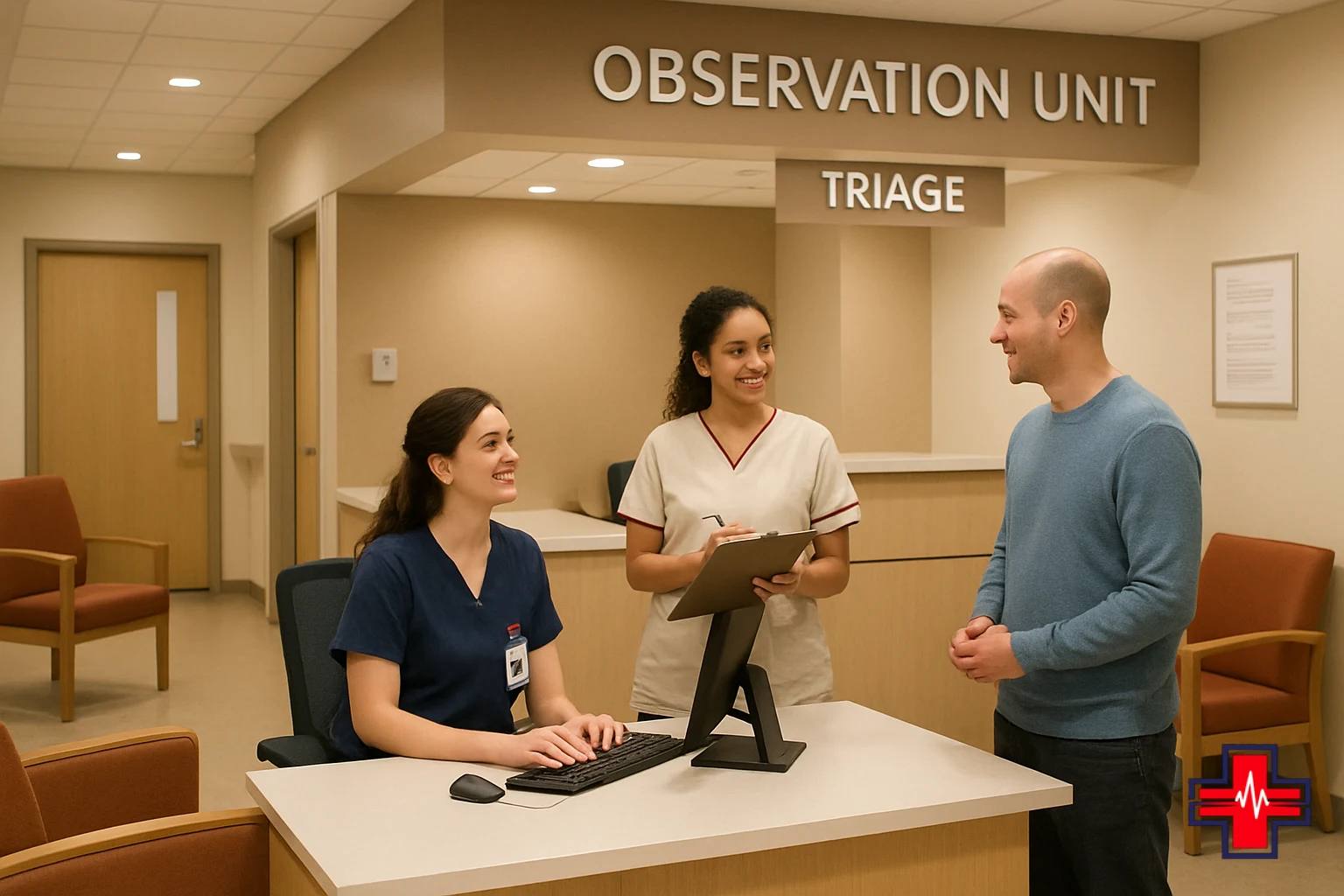
When Is Observation Services the Right Choice?
Several common clinical scenarios warrant observation services rather than immediate discharge or inpatient admission. Recognizing these situations helps patients understand why an ER physician might recommend staying in the observation unit.
Chest Pain with Unclear Etiology: A patient presents with chest discomfort but initial electrocardiogram and blood tests are not conclusive for a heart attack. Serial troponin levels (cardiac enzyme markers) drawn over several hours help rule out acute coronary syndrome. Chest pain ER observation allows time for these serial measurements and stress testing if appropriate. This is one of the most common reasons for observation admission.
Fever with Unclear Source: A patient has fever, elevated inflammatory markers, and nonspecific symptoms. Fever treatment observation enables urine cultures, blood cultures, and imaging (such as chest X-ray or abdominal ultrasound) to incubate and return over hours. If infection is confirmed, the patient may be admitted; if cultures are negative and symptoms resolve, discharge is appropriate.
Acute Neurological Symptoms: A patient experiences sudden headache, dizziness, or transient neurological deficit. Observation allows time for imaging (CT or MRI), lumbar puncture if indicated, and neurological reassessment to rule out stroke, subarachnoid hemorrhage, or meningitis.
New-Onset Atrial Fibrillation: A patient with rapid heart rate is found to have an irregular rhythm. Observation includes rate control, anticoagulation consideration, and electrolyte correction while the patient is monitored continuously on cardiac telemetry. Many episodes stabilize within hours.
Severe Dehydration Requiring IV Fluids: A patient with gastroenteritis, hyperemesis, or other cause of dehydration may receive several liters of intravenous fluid over hours. Observation allows reassessment after fluid repletion and repeat electrolyte checking before discharge.
Medication Management or Toxin Exposure: Patients with allergic reactions or medication side effects benefit from observation to ensure symptom resolution and rule out delayed complications.
Observation Services vs. Inpatient Hospital Admission
A common source of confusion is the distinction between observation status and inpatient admission. Both occur in a hospital, yet they carry different clinical, financial, and regulatory implications.
Observation Status: The patient is held for diagnostic evaluation and monitoring but is expected to be discharged or admitted as an inpatient by the end of the observation period (typically 23 hours or less). Observation does not count as an "inpatient day" for Medicare or insurance purposes, which can affect copay amounts and coverage for skilled nursing facility placement. Insurance often considers observation a hospital service with a separate cost-sharing structure.
Inpatient Admission: The patient is admitted to a hospital floor (such as cardiology, neurology, or general medicine) with the expectation of staying one or more nights. Each night counts as an inpatient day, and the patient receives care from hospital staff, nurses, and physicians. Inpatient status qualifies the patient for higher levels of care, including continuous monitoring, consultations, and complex procedures.
The decision to upgrade from observation to inpatient status is made by the attending physician based on clinical judgment. If a diagnosis is confirmed that requires ongoing monitoring or treatment (such as confirmed pneumonia, acute heart failure, or stroke), the patient is admitted as an inpatient. If the condition is clarified and deemed safe for outpatient management, the patient is discharged.
From a financial standpoint, observation is often less expensive than inpatient admission because the length of stay is defined and limited. However, cost varies widely based on insurance plan and facility. Patients should ask their ER provider or billing staff about expected out-of-pocket costs during observation.

ER Of Fort Worth's Observation Unit: What to Expect
ER Of Fort Worth, located at 4561 Heritage Trace Parkway, Suite 117, operates a dedicated observation unit available 24 hours a day, 7 days a week. The facility serves Fort Worth residents as well as patients from nearby communities including Keller, Alliance, Saginaw, Haslet, Watauga, Roanoke, North Richland Hills, Haltom City, Bedford, Southlake, Grapevine, and Flower Mound.
What Our Observation Unit Provides:
- Comfortable observation beds in a private or semi-private setting.
- Continuous pulse oximetry and cardiac monitoring where clinically indicated.
- Rapid access to blood tests, electrocardiograms, ultrasound, and imaging.
- Nursing staff trained in short-stay patient protocols and discharge planning.
- Board-certified emergency physicians who manage the observation service and make disposition decisions.
- Access to specialists for telephone consultation or in-person evaluation if needed.
- IV medications, fluids, and medications by mouth as ordered.
- Meal service and comfort amenities.
- Clear communication about the observation plan and expected timeline.
Our ER doctors prioritize efficient diagnosis and safe discharge. We understand that patients want clarity about their condition and a pathway to recovery—whether that means going home with prescribed follow-up or being admitted for more intensive care.
If you are near ER Of Fort Worth in Fort Worth or are a resident of the surrounding communities and are unsure whether you need emergency care, online check-in is available to streamline your arrival. You can also call us at 817-945-4200 to discuss your symptoms with a nurse who can advise on whether an urgent care visit, ER evaluation, or observation service is appropriate.
Observation Services for Fort Worth and North Texas
Residents throughout the Fort Worth area benefit from convenient access to observation services without traveling to a large hospital system. The freestanding Fort Worth emergency room model allows faster triage, shorter wait times, and personalized care planning compared to many hospital-based ERs.
Whether you live in Fort Worth proper or in surrounding areas like Keller, Alliance, or other North Texas communities, ER Of Fort Worth's observation unit is designed to meet urgent diagnostic and monitoring needs locally. This means you do not have to navigate a large hospital complex or endure lengthy ER waits before reaching an observation bed.
Common Reasons Fort Worth Patients Choose Observation:
- Fever in children or adults requiring diagnostic workup and fluid management (see fever treatment ER services).
- Acute UTI symptoms with systemic signs requiring IV antibiotics.
- Respiratory symptoms concerning for pneumonia or other infection.
- Chest pain, palpitations, or syncope requiring cardiac evaluation.
- Shortness of breath of unclear etiology.
- Acute back pain with neurological signs or severe symptoms requiring imaging and specialist input.
- Migraine or severe headache with atypical features or failed outpatient treatment.
- Recent fall or trauma with delayed symptom development.
Each scenario is individualized. The emergency physician at ER Of Fort Worth evaluates your condition, explains the observation recommendation, and ensures you understand the plan before admission to the unit.
Frequently Asked Questions About Observation Services
Frequently Asked Questions
If I am placed in observation, does that count as being admitted to the hospital?
Observation status is distinct from inpatient admission. You are in a hospital setting and receive hospital-level monitoring and care, but observation does not automatically count as an inpatient day for insurance or Medicare purposes. This distinction affects billing and coverage for follow-up services. Ask your ER provider or billing representative to clarify your specific insurance situation.
Can I have a family member stay with me during observation?
Yes. Most observation units welcome a designated caregiver or family member to remain at the bedside for support and to help with communication. Check with the nursing staff about visiting hours and any unit-specific policies at ER Of Fort Worth.
What if my condition worsens during observation?
Patients in observation are continuously monitored. If your condition deteriorates or changes, nursing staff alert the physician immediately. If inpatient admission or transfer becomes necessary, that decision is made and implemented promptly.
How much does observation services cost, and will my insurance cover it?
Observation service costs vary by insurance plan, facility, and services rendered (labs, imaging, specialist consultation). We cannot quote a specific price, but you can contact ER Of Fort Worth at 817-945-4200 or ask our billing staff about estimated costs and your insurance coverage before or during your stay.
What happens after I am discharged from observation?
Before discharge, the physician discusses findings, provides a discharge summary, prescribes any needed medications, and arranges outpatient follow-up appointments (primary care, specialist, or repeat labs). You receive written discharge instructions and contact information for questions that arise at home.
How is observation different from urgent care?
Urgent care centers typically handle minor injuries and acute illnesses without the ability to admit for extended monitoring or provide continuous telemetry and IV infusions. Observation units offer hospital-level diagnostics and monitoring for conditions that need more time and intensity than urgent care can provide but may not require full inpatient admission.
Can I request observation if I think I need it?
Observation placement is a clinical decision made by the emergency physician based on your symptoms, exam findings, and test results. You cannot self-request observation, but you can communicate your concerns to the ER provider, who will make the appropriate care recommendation.
If you are experiencing a life-threatening emergency, call 911 or go to the nearest emergency room immediately.
Do not delay calling 911 for severe symptoms such as chest pain, shortness of breath, severe headache, loss of consciousness, uncontrolled bleeding, or signs of stroke. Observation is not appropriate for immediately life-threatening conditions.